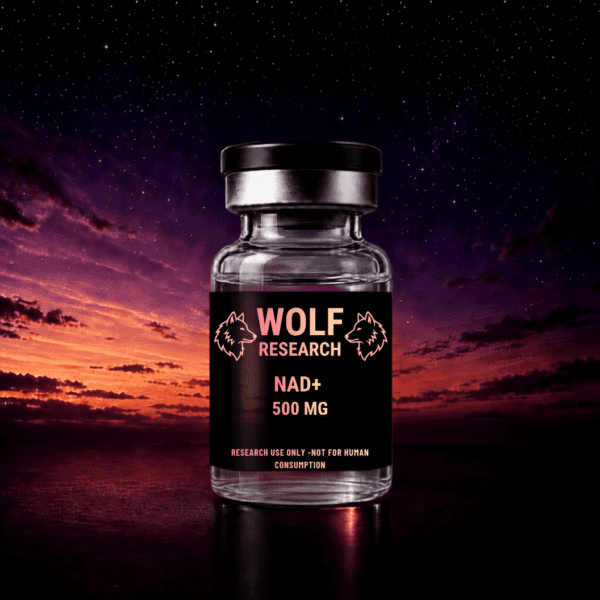
Quick Overview: Nicotinamide adenine dinucleotide (NAD+) is a coenzyme that participates in cellular redox reactions, energy production, DNA-repair signaling, and other enzyme systems. Human research on administered NAD+ remains limited, and published parenteral studies do not establish a general protocol. This high-purity NAD⁺ solution is designed for laboratory research involving aging, mitochondrial function, and sirtuin activation pathways.
NOTE: This content is intended for educational purposes only and does not constitute medical advice, any diagnosis, or any treatment. This is strictly a research use only compound and not approved by regulatory agencies for human or veterinary therapeutic use or application.
NAD⁺ is an essential redox cofactor in mitochondrial energy production, particularly in oxidative phosphorylation. It shuttles electrons from glycolysis and the TCA cycle to the electron transport chain, enabling ATP generation.
Depletion of NAD⁺ levels is frequently observed in aged or metabolically stressed cells, making it a target in studies of mitochondrial dysfunction, senescence, and metabolic disorders.
Sirtuin Activation and Epigenetic Regulation-
NAD⁺ is a required co-substrate for sirtuin deacetylases (SIRT1–SIRT7), which are involved in DNA repair, chromatin remodeling, and gene expression. These enzymes regulate cellular longevity, inflammation, and metabolic adaptation, making NAD⁺ supplementation a critical variable in aging and epigenetic studies.
DNA Repair and PARP Function-
NAD⁺ is also a substrate for poly (ADP-ribose) polymerases (PARPs), which mediate DNA damage response and repair mechanisms. When DNA strand breaks occur, PARP enzymes consume NAD⁺ to signal for repair machinery, especially under oxidative stress.
In research models, excessive PARP activation can lead to NAD⁺ depletion and subsequent ATP loss, contributing to cell death. Thus, NAD⁺ is studied in contexts of genomic stability, neurodegeneration, and cell survival signaling.
Immunometabolism and Inflammatory Regulation-
Recent research links NAD⁺ to immune cell regulation, particularly via CD38 and SIRT1 pathways in macrophages and T-cells. NAD⁺ modulates pro-inflammatory cytokine expression and T-cell function, making it a point of interest in immunometabolic research.
Studies are exploring how NAD⁺ levels influence cellular redox states and inflammatory gene transcription, especially in chronic inflammatory or autoimmune models.
NOTE: This content is intended for educational purposes only and does not constitute medical advice, any diagnosis, or any treatment. This is strictly a research use only compound and not approved by regulatory agencies for human or veterinary therapeutic use or application.

 0.00064
 0.02282
 39.99000